Hand Tools vs Power Tools: Choosing the Right Tool for the Job
Every trade professional hits that moment on the jobsite: reach for the hand tool or fire up the power tool. Pick wrong and you're either grinding through a fast job with a slow tool, or fighting a power tool in a space it was never built for. Hand tools and power tools each dominate in specific conditions — and if you're an electrician, plumber, HVAC tech, pipefitter, or general contractor working in Houston in 2026, knowing which one wins where is as fundamental as knowing the trade itself.
Why the Hand Tools vs Power Tools Debate Still Matters in 2026
This isn't a new question — but it's a more important one now than it's ever been. Cordless power tool technology has matured to the point where battery runtime, torque, and compact size have closed the gap that once made hand tools the obvious default for dozens of tasks. At the same time, professional hand tool manufacturers have raised their quality ceiling significantly — forged steel construction, ergonomic grips, and trade-specific designs that make a quality hand tool a precision instrument, not a fallback.
The professionals who work fastest — and get called back — carry both and know exactly when to use each. For a full view of what professional power tools are available for your trade right now, see Best Power Tools for Professionals: 2026 Contractor Picks. And for trade-grade hand tools, browse the General Purpose Hand Tools collection at Tool Mart Houston.
The Real Question: Which Tool Wins Here?
Hand tools and power tools aren't competing for the same jobs — they cover different ends of the same work spectrum. Hand tools win on precision, access, and portability. Power tools win on output, speed, and sustained force on demanding materials. Most real jobsite decisions come down to four factors: task volume, access constraints, power availability, and cost justification. We break all four down in depth in the Key Factors section below.
Hand Tools — Where They Win on the Jobsite
Quality hand tools are not the cheap option or the backup plan. In the right situations, they are the correct tool for the job — full stop. Here's where hand tools consistently outperform power alternatives for trade professionals.
1. Precision Work and Fine Adjustments
When the margin for error is small — threading a fitting, torquing a terminal lug, adjusting a conduit bend — hand tools give you direct tactile feedback that power tools can't replicate. You feel the resistance change as a fitting seats. You feel the slip before it happens. That feedback isn't a limitation of hand tools; it's a feature. Power tools apply force at a rate the operator doesn't fully control at the micro level, which makes them the wrong choice any time the work requires graduated, feel-based force application.
2. Tight Spaces and Restricted Access
Drop ceilings, panel boards, junction boxes, crawl spaces, mechanical chases — trade work happens in places power tools either can't fit or can't safely operate. A quality pair of Channellock 420 Tongue & Groove Pliers or a set of Klein Tools screwdrivers and wire strippers will reach spaces that a drill/driver with a chuck can't touch. In confined-space electrical and plumbing work especially, slim-profile hand tools are the only practical option.
3. No Power Required — Works Anywhere on Site
Cordless tools have largely closed the power availability gap, but they haven't eliminated it. A dead battery mid-pull, a generator already running another circuit, work in cold environments that tank battery performance — all of these scenarios make hand tools the fallback that never lets you down. On active construction sites before permanent power is established, or in remote utility work far from any charging source, hand tools don't care about infrastructure.
4. Long-Term Durability With Minimal Upkeep
A quality pair of pliers, a well-maintained set of screwdrivers, or a forged wrench can outlast three or four generations of power tools with nothing but occasional cleaning and edge maintenance. No brushes to replace, no batteries to degrade, no electronics to fail in wet conditions. Brands like Channellock, Klein, and Knipex build hand tools for decades of professional use — and their warranty programs back that up.
Power Tools — Where They Win on the Jobsite
When the job is big, the material is hard, or the task repeats dozens of times a day, power tools are the right answer. Here's where they deliver results hand tools simply can't match.
1. Speed and Output on Repetitive Tasks
Driving 200 screws, drilling 50 holes through steel stud, cutting conduit for a full floor rough-in — these are jobs where the math doesn't favor hand tools. Power tools compress hours of hand-tool work into minutes. On production commercial work, that speed difference is the margin between a profitable job and one that runs long. Any task you're performing more than ten times in a row is a candidate for a power tool.
2. Heavy-Duty Materials and Dense Stock
Drilling through concrete, cutting heavy-wall steel, driving large fasteners into timber — these tasks require sustained force at a level that fatigues an operator quickly with hand tools, or simply can't be done efficiently at all. A power tool's motor applies consistent force throughout the cut or drive regardless of material hardness. For concrete anchor work, structural fastening, or heavy conduit knockout work, power tools aren't optional — they're the specification.
3. Cordless Portability for Modern Jobsites
The M18 platform from Milwaukee — and comparable systems from DeWalt and Bosch — have made cordless power tools genuinely capable on commercial jobsites. A single battery platform powers a drill/driver, impact driver, reciprocating saw, and band saw from one battery system and one charger. Browse the full power tools collection at Tool Mart Houston to see what's available across platforms and brands.
Key Factors When Choosing Hand Tools vs Power Tools
Job Scale and Task Volume
Volume is the clearest decision driver. If you're making fewer than ten of the same move — tightening a handful of fittings, making three cuts — a hand tool is usually faster once setup time is factored in. If you're repeating that same move fifty or a hundred times, a power tool saves significant time and physical output. Ask: how many repetitions does this task involve today? The answer almost always points directly to the right tool type.
Access, Space, and Noise Constraints
Physical access determines the tool before anything else does. A 3/8 in drive ratchet fits in an electrical panel. A drill/driver often doesn't. In occupied buildings, noise restrictions may prohibit power tools during business hours — hand tools solve that problem without scheduling delays. In hospital, hotel, and occupied office renovation work, hand tools are frequently the only compliant option for live-floor work regardless of what's faster in open space.
Power Availability on Site
Cordless platforms have nearly eliminated this constraint — but not entirely. Cold temperatures reduce lithium-ion battery capacity significantly, sometimes up to 50% below 20°F. Early-stage construction without temporary power creates battery management challenges. Remote outdoor utility work can be far from any charging source. For professionals building a cordless platform and managing battery specs, How to Read Power Tool Specifications covers voltage, amp-hour ratings, and runtime calculations in plain terms.
Budget, Cost-Per-Use, and Long-Term ROI
Hand tools cost less upfront, but the cost-per-use calculation favors power tools on high-volume work. A $400 cordless combo kit that eliminates two hours of labor on every job pays for itself in a week for a busy contractor. Quality hand tools have a lower total cost of ownership over a long career — no batteries, no service parts, no platform lock-in. The right strategy: invest in quality hand tools first, then add power tools as your work volume justifies each one.
Side-by-Side Comparison: Hand Tools vs Power Tools
| Factor | Hand Tools | Power Tools |
|---|---|---|
| Speed | Best for low-volume, precision tasks | Faster on repetitive, high-volume work |
| Upfront Cost | Lower — quality sets from $30–$300 | Higher — pro combo kits from $150–$600+ |
| Precision & Control | High — direct tactile feedback throughout | Variable — speed/clutch settings help |
| Portability | Maximum — no power source required | High — cordless platforms are highly mobile |
| Noise Level | Low — no restrictions on occupied sites | Moderate–high — may require PPE or scheduling |
| Maintenance | Minimal — clean, oil pivot points, sharpen edges | Regular — battery, brush, chuck, belt inspection |
| Operator Fatigue | Higher on high-volume repetitive tasks | Lower — motor absorbs force output |
| Lifespan | Decades with minimal care | 5–10 years with proper maintenance |
| Access & Profile | Fits anywhere — panels, boxes, chases | May be too large for confined spaces |
| Cold Weather Performance | Unaffected by temperature | Battery capacity drops up to 50% below 20°F |
Trade-by-Trade Tool Priority Guide
Different trades have fundamentally different tool priorities. An electrician's daily hand tool needs look nothing like a pipefitter's. Use this table to see which categories dominate your trade and build your toolbox accordingly.
| Trade | Essential Hand Tools | Essential Power Tools | Top Brands at Tool Mart |
|---|---|---|---|
| Electrician | Wire strippers, lineman's pliers, insulated screwdrivers, fish tape, voltage tester | Cordless drill/driver, impact driver, knockout tool, reciprocating saw | Klein (hand), Milwaukee / Greenlee (power) |
| Plumber | Pipe wrenches, Channellock pliers, tubing cutters, hand reamer, basin wrench | RIDGID power drive, cordless press tool, reciprocating saw, drain machine | Channellock (hand), RIDGID / Milwaukee (power) |
| HVAC Tech | Tin snips, flaring tool, hand pipe bender, manifold gauge set, hex keys | Cordless drill, sheet metal shears, reciprocating saw, vacuum pump | Klein / Channellock (hand), Milwaukee / DeWalt (power) |
| Pipefitter | Chain vises, pipe wrenches, hand files, levels, tape measure, hammers | Threading machine, power drive, angle grinder, band saw | Channellock / Klein (hand), RIDGID / Milwaukee (power) |
| General Contractor | Hammers, pry bars, chisels, hand saw, utility knife, torpedo levels | Circular saw, drill/driver combo, impact wrench, oscillating multi-tool | Channellock / Klein (hand), Milwaukee / DeWalt / Bosch (power) |
Care & Maintenance — Keeping Both Tool Types Job-Ready
The gap between a $50 hand tool that lasts 30 years and one that fails in three is almost entirely maintenance. After every job: wipe down hand tools, apply a thin coat of oil to adjustable jaws and pivot points, and inspect cutting edges for chips or burrs. A set of wire strippers with nicked blades damages conductor insulation. A wrench with a worn jaw rounds fastener heads. These are $0.10 maintenance problems that create expensive callbacks — catch them early.
Power tools demand a more structured schedule. After each use: clear vents of dust, inspect battery contacts, and check bit retention systems for wear. Weekly on active jobsites: test batteries for swelling or corrosion, verify speed control and trigger function, and confirm all safety mechanisms are operational. For a full preventive maintenance guide covering motors, batteries, storage temperature, and corded tool inspection, see the Power Tool Maintenance Guide: Cleaning, Battery & Storage.
- Hand tool pivot points: Oil monthly; remove grit buildup that creates jaw slop and reduces grip
- Cutting edges: Sharpen before they fail — dull edges damage work and increase operator force
- Power tool batteries: Store at 40–80% charge; never store fully depleted; protect from extreme heat or cold
- Chucks and bit holders: Clean jaws quarterly; check for bit slippage under load before it becomes a dropped fastener mid-height
- Corded tool cables: Inspect full jacket length before each use; replace at first sign of exposed conductor
- Storage: Hang hand tools; rack power tools — never pile either in a drawer where contact causes edge and surface damage
Well-maintained tools keep your crew productive and your equipment budget predictable. For proven strategies on maximizing your tool investment on the jobsite, read 5 Proven Ways to Maximize Jobsite Productivity.
Tool Ratings and Safety Standards Explained
ANSI (American National Standards Institute) sets performance and dimensional standards for professional hand tools through the ANSI/ASME B107 series — covering torque tools, wrenches, striking tools, and pliers. When a manufacturer claims ANSI compliance, it means the tool has been tested against published strength and geometry requirements, not just marketing copy. For trade professionals specifying tools by contract, ANSI compliance is a meaningful quality floor, not a brand claim.
UL (Underwriters Laboratories) certification is most relevant for power tools and extension cords, verifying electrical insulation, thermal protection, and fire resistance against third-party testing standards. On jobsites governed by OSHA 29 CFR 1926, UL-listed power tools are required for electrical construction work. Look for the UL listed or UL recognized mark on the tool or packaging — this indicates third-party verification, not self-certification by the manufacturer.
ASTM F1505 and IEC 60900 are the standards for 1,000V-rated insulated hand tools used in electrical work near energized conductors. These standards define the insulation construction, test voltage, and marking requirements for tools rated for live electrical work. NFPA 70E specifically references insulated tools as a required control measure when working within the arc flash boundary. If your crew performs live work, insulated-rated tools aren't optional — they're a NFPA 70E compliance requirement.
Where to Buy Hand Tools and Power Tools in Houston
Tool Mart Houston carries professional-grade hand tools and power tools from Klein, Channellock, Milwaukee, DeWalt, Bosch, RIDGID, and Greenlee — the brands trade professionals in Houston rely on daily. Shop the hand tools collection or the power tools collection online, visit in-store for hands-on guidance, or submit a quote request for contractor pricing on larger orders.
Frequently Asked Questions
Are hand tools or power tools better for electricians?
Both are essential — they cover different parts of the work. Electricians rely on hand tools (wire strippers, lineman's pliers, screwdrivers, voltage testers) for termination, panel work, and confined-space wiring where precision and access are everything. Power tools (cordless drill, impact driver, knockout tool) handle fastening, drilling, and conduit knockout at production scale. The strongest electrician toolkit carries both — Klein for hand tools, Milwaukee or Greenlee for power.
Can I get by with just hand tools on a commercial job?
For small or low-volume tasks, yes. For production commercial work — rough-in across multiple floors, structural fastening, repetitive drilling — trying to do power tool work with hand tools costs you significant time and physical output. On commercial jobs, the labor cost of working slowly far outweighs the cost of a quality cordless platform.
What's the most versatile power tool kit for a contractor starting out?
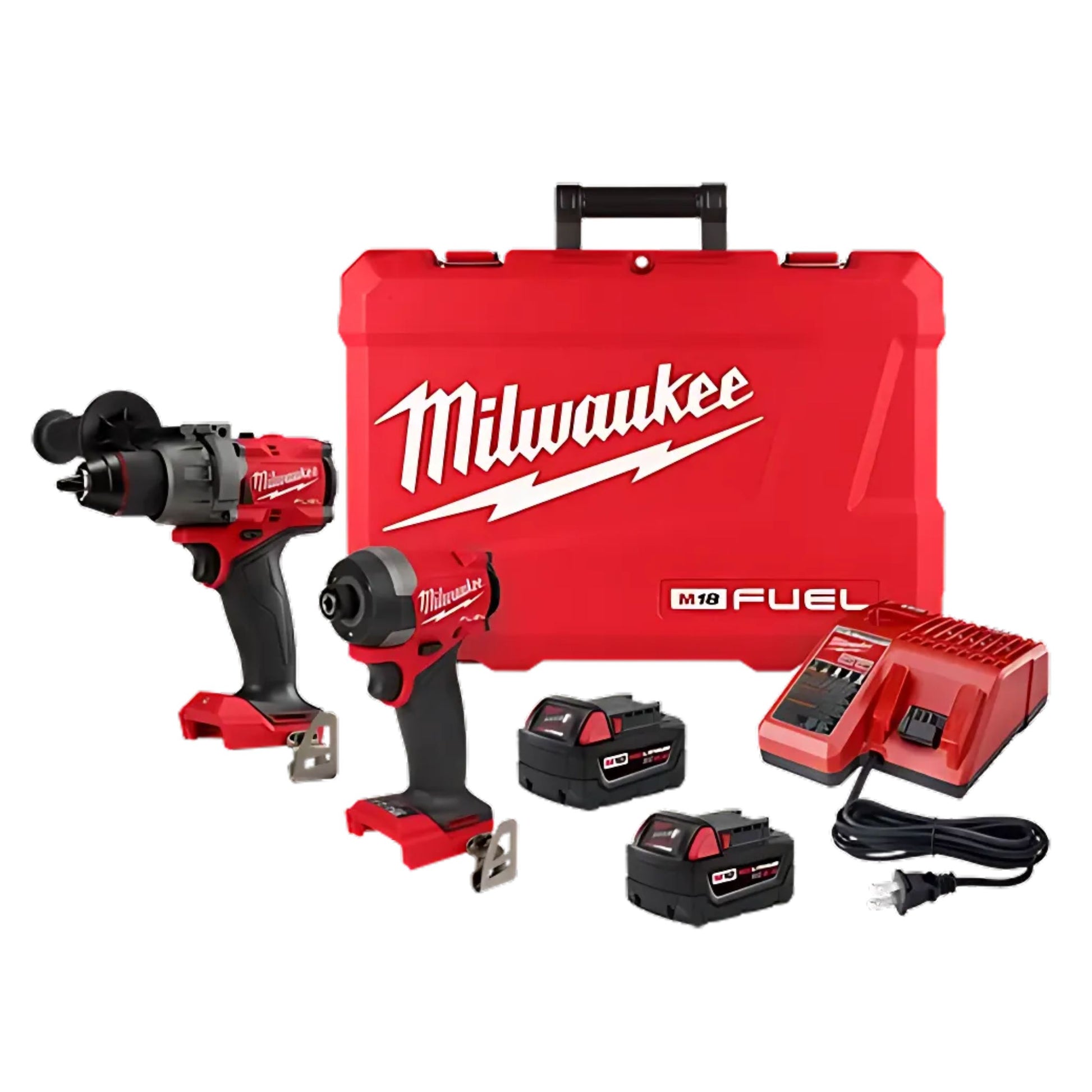
A hammer drill/driver and impact driver combo on an 18V or 20V platform covers the widest range of fastening, drilling, and light demo tasks you'll face daily. The Milwaukee M18 FUEL 2-Tool Combo Kit 3697-22 delivers exactly that — brushless motor, 1,400 in-lbs of torque, and entry to the M18 platform, which currently offers the widest range of compatible professional tools on the market.
How do I choose between cordless and corded power tools?
Cordless for mobility and jobsite flexibility. Corded for stationary, long-duration tasks where consistent power matters more than portability — table saws, continuous-run grinders, and any application where battery runtime becomes a limiting factor. Most contractors go primarily cordless for drill/driver and cutting work, and keep corded for heavy stationary applications. On the M18 platform with XC5.0Ah batteries, runtime on most production tasks is no longer a meaningful constraint.
Do quality hand tools actually need maintenance?
Yes — and skipping it costs you. Cutting edges on wire strippers and snips dull with use and start damaging conductor insulation and sheet metal edges when they're below spec. Plier and wrench pivot points accumulate grit that creates slop in the jaw, reducing grip and control. Plated surfaces protect against corrosion — once worn away, seized pivot points follow. Wipe down, lubricate, and inspect cutting edges after every job. It takes two minutes and extends tool life by years.
Final Recommendation
Don't treat this as a competition — treat it as a two-part investment. Start with quality hand tools from Klein and Channellock. These are tools you'll use on every job, in every access point a power tool can't reach, for the length of your career. Buy the quality tier once and they'll outlast everything else on your belt by a decade.
Then build your power tool platform around your volume. If you're doing production fastening, drilling, and cutting daily, the Milwaukee M18 FUEL 2-Tool Combo Kit is the right starting point — brushless motor, top-tier runtime, compact profile, and entry to the Milwaukee M18 platform, the widest compatible professional tool ecosystem available. As your work volume grows, add tools to the same battery system rather than starting over on a new platform.
The professionals who get called back for the next job show up with the right tool for every task — not just the ones they prefer. That means both. Invest in both. Maintain both.
Build your hand tool foundation first. Add power tools as your volume justifies each one. Buy both from Tool Mart Houston — where the professional tier is in stock and the staff knows the trade.
Shop Professional Hand Tools & Power Tools at Tool Mart Houston.
Klein, Milwaukee, Channellock, DeWalt, RIDGID, Greenlee — in stock, trade-grade, ready for the job.